
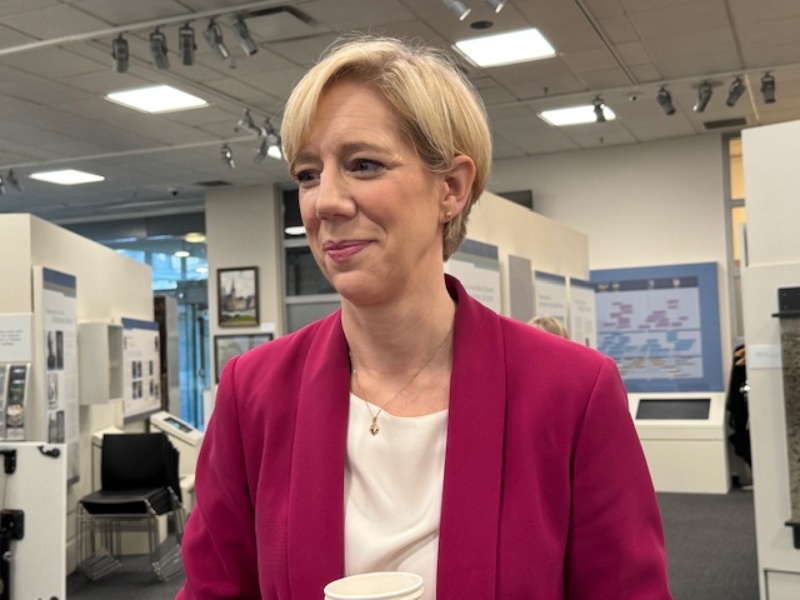
Picture: RBNZ Governor Anna Breman (Supplied)
Economists at the major banks had been divided about what RBNZ would decide but will likely be surprised that the monetary policy committee (MPC) managed to reach its decision by consensus, unlike its last decision in May at which governor Anna Breman used her casting vote to break a tie.
However, the minutes of the meeting showed that external committee members Prasanna Gai and Hayley Gourley think the risks to inflation are skewed to the upside while the third external member, Carl Hansen, sided with the three RBNZ members in assessing the risks “as broadly balanced.”
The central bank warned that “some further reduction in monetary stimulus is likely to be required to return inflation to the 2% target mid-point,” but said the timing of further hikes “is highly uncertain.”
The New Zealand dollar spiked from 56.88 US cents immediately before the announcement to as high as 57.05c before retracing somewhat.
RBNZ now expects inflation will have peaked at 3.9% in the June quarter, lower than its previous 4.2% forecast, and that it will fall to 3.3% in the current quarter, largely reflecting smaller direct price effects due to lower oil prices.
It expects inflation to return to 2% by mid-2027, while noting that non-tradeable inflation – domestically-driven prices such as electricity and rates, “has been persistent despite spare capacity in the economy.”
It said domestic economic activity slowed in the June quarter but that growth is expected to resume this quarter with lower fuel prices supporting a recovery in spending.
The committee also discussed the run-down of the about $55 billion large-scale asset programme (LSAP), agreeing to bring forward the final sale of $141 million of NZ government bonds to June 2027, a month earlier than scheduled, and selling $392 million of Local Government Funding Agency bonds due to mature after June 2027.
“The committee approved the proposal noting it had no impact on monetary stimulus given the relatively small quantity of holdings impacted,” the minutes of the meeting said.
It also discussed the potential risk of “a correction in AI-related asset prices.” as well as the impact of a re-escalation of Middle East tensions.
Assistant governor Karen Silk had noted that the falling New Zealand dollar “could, if sustained, increase imported inflation,” while chief economist Paul Conway said that firms’ price-setting behaviour could prove more sensitive to further cost increases, “particularly after an extended period of elevated inflation.”
Silk said that slower than expected net immigration could weigh on rental inflation and house prices.
Hansen noted the high non-tradeables inflation and said that “administered price inflation” could remain persistently high.
Breman said that if demand remains weak, firms may have less ability to pass higher costs to consumers.




Comments
No comments yet.
Sign In to add your comment